
previous

next

index

home
Wise fin-keel Kite
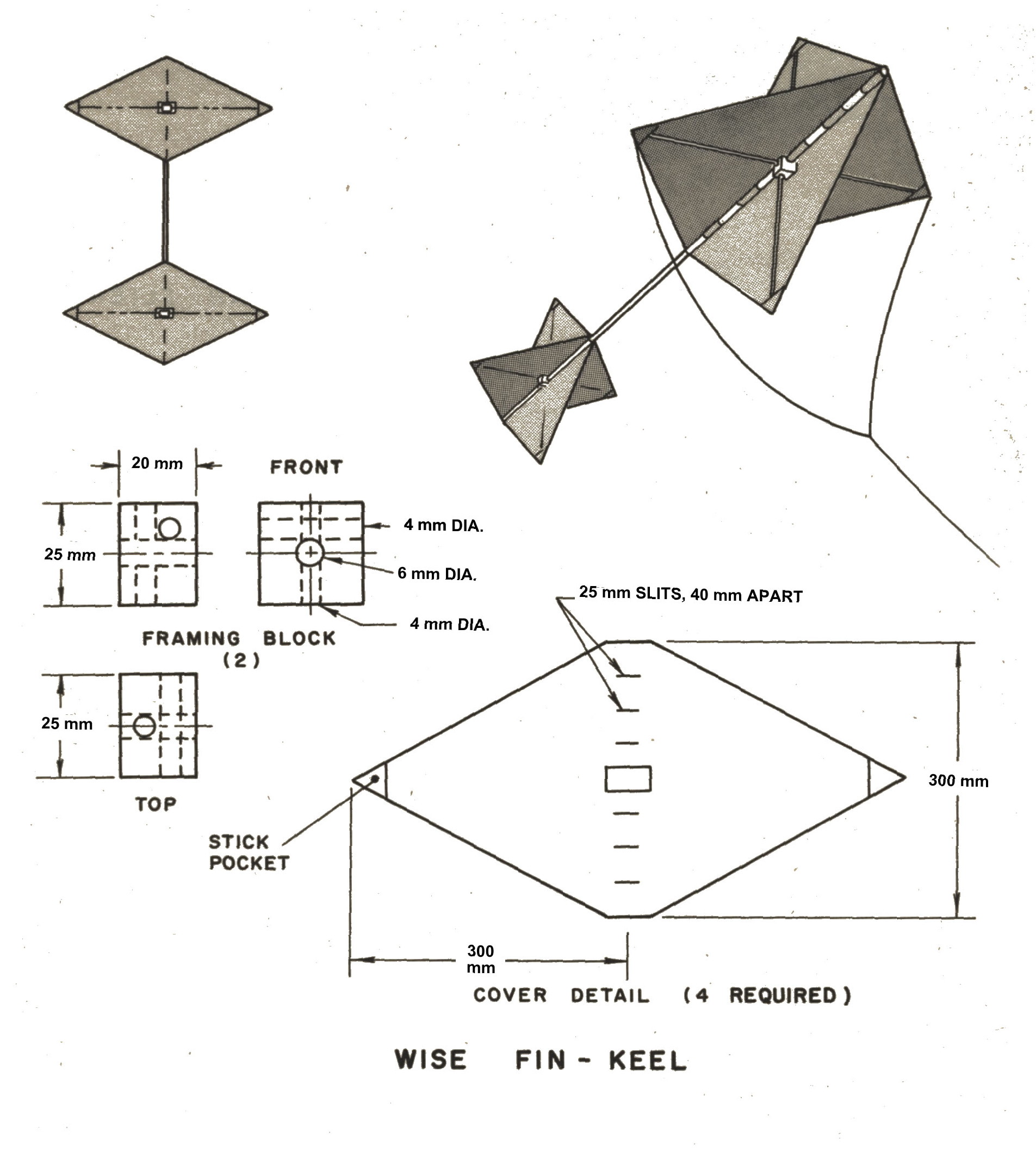
Lieutenant Hugh D. Wise, in his experiments with kites in the 1890s for military observation and signalling purposes, toyed briefly with several very uncommon types. One of these was an especially easy kite to duplicate, and is presented here as modified by Frank Scott.
It is easiest to stack up four thicknesses of covering material (e.g. Tyvek) and cut out the pieces all at once. But do not cut out the rectangular hole or slits until separating the pieces and joining them, in pairs, right down the centreline with a strip of double-sided tape. The final cuts may then be made, and pockets formed at each tip end to receive the sticks.
A pair of 25 mm. square wooden blocks is now drilled as per the sketch. Then “thread” the covers, alternating sides between slits, onto the 6 mm. diameter longeron carbon, taking care to add the square wooden framing blocks as their turns come. With these components strung onto the longeron, pull the covers taut and secure the corners to the longeron with tape. Then, making sure the little framing blocks are lined up with each other, you can glue these in place.
All that remains is to set up your Wise Fin-Keel by inserting the long carbon spars through the framing blocks and securing the ends in the pockets provided. Likewise, the smaller spars are inserted between the framing blocks and fin-tip pockets.
The bridle is a two-leg bridle attached to the spar tips of the forward wings. For strength, it is advisable to attach the bridle to the tips of the longer single-piece spars.
The Fin-Keel has relatively little wing area for its size and weight and will thus require a moderate breeze for flight.
Materials:
carbon tube 6 mm. x 1000 mm. (1)
carbon rods 4 mm. x 600 mm. (2)
carbon rods 4mm. x 300 mm. (4)
wooden blocks 25 x 25 x 20 mm. (2)
¾ square metre Tyvek.
superlue as required.